
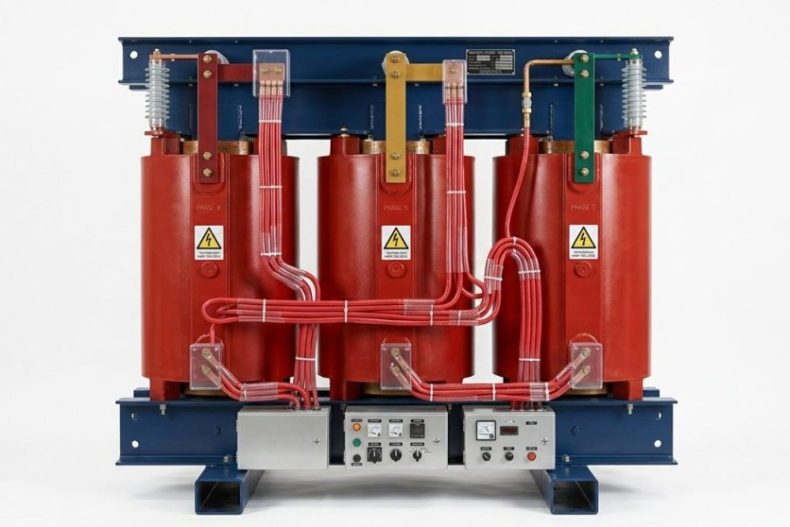
Oil-filled transformers still dominate outdoor substations. Indoors—basements, malls, hospitals, IT parks, and high-rise plant rooms—the decision usually shifts to a dry type transformer. The challenge is not whether dry type is safer. It is choosing the right construction, rating, and insulation class so the unit runs cool, stays compliant, and does not become a bottleneck when load grows.
Jaybee Industries has manufactured power and distribution transformers in India since 1981. Below is a practical selection framework we use when engineering dry-type units for commercial and industrial sites.
What Makes a Transformer “Dry Type”?
A dry type transformer uses air (and solid insulation) for cooling and dielectric strength instead of mineral or ester oil. There is no oil tank, no oil sampling routine, and no risk of oil leak or oil fire. That is why dry-type designs are preferred for:
- Indoor electrical rooms with limited floor area
- Occupied buildings where fire codes are strict
- Facilities near people traffic (hospitals, airports, hotels, offices)
- Sites where oil containment and fire barriers are expensive or impractical
Jaybee dry type transformers are offered in 1-phase and 3-phase, typically from 10 kVA to 1000 kVA (and higher ranges depending on construction), for 11 / 22 / 33 kV class, with or without OLTC.
CRT, VPI, or VPE: Which Construction Fits Your Site?
Not every dry type transformer is built the same way. Matching construction to environment matters more than brand claims.
Cast Resin Type (CRT)
Windings are encapsulated in epoxy resin. CRT units handle humidity, dust, and corrosive atmospheres better and offer strong fire performance. They suit coastal plants, chemical surroundings, underground rooms, and high-occupancy buildings.
Vacuum Pressure Impregnated (VPI)
Windings are impregnated under vacuum with varnish. VPI is often the cost-effective choice for cleaner, controlled indoor rooms with moderate humidity and lower environmental stress.
Vacuum Pressure Encapsulated (VPE)
A middle path between open/VPI and full cast resin—useful when you need stronger environmental protection than basic VPI without always going to heavy cast-resin duty.
Rule of thumb: If the room sees moisture, pollution, or critical life-safety loads, lean CRT. If the environment is dry, filtered, and well ventilated, VPI can be the smarter commercial choice.
Seven Specs You Should Lock Before Ordering
- kVA rating with real diversity—not brochure optimism
Size for present load plus planned expansion (typically 20–30% headroom for commercial growth). Undersizing causes hot spots; chronic oversizing wastes capital and space. - Primary and secondary voltage
Confirm utility / HT voltage (11, 22, or 33 kV class) and LT voltage (usually 433 V / 415 V systems in India). Wrong ratio means redesign, delay, and retesting. - Impedance and short-circuit withstand
Impedance affects fault levels, voltage regulation, and downstream switchgear selection. Align transformer impedance with your protection study—not only with “standard catalogue” values. - Losses and efficiency class
No-load and load losses drive lifetime electricity cost. For continuous commercial duty, a slightly higher purchase price with lower losses often wins on total cost of ownership—especially under rising tariffs. - Temperature rise and insulation class
Dry type units depend on air flow. Confirm ambient temperature in the electrical room (many Indian plant rooms exceed design assumptions in summer). Specify temperature rise limits and ensure the enclosure and ventilation plan match. - Enclosure (IP) and installation layout
Indoor rooms need the right IP degree, cable entry, clearance for HV/LV terminations, and access for IR scanning. Poor room design—not the transformer—is a common cause of early thermal stress. - Tap changer requirement
Off-circuit taps suit stable voltage. Where supply voltage swings widely, evaluate OLTC so secondary voltage stays usable without frequent shutdowns for tap changes.
Where Dry Type Transformers Perform Best
| Application | Why dry type fits |
|---|---|
| Hospitals & healthcare | Fire safety near patients and critical loads |
| Data centres & IT parks | Indoor reliability, lower contamination risk |
| Malls, hotels, high-rises | Compact footprint, no oil fire concern |
| Airports & metro facilities | Occupied public infrastructure |
| Industrial indoor substations | Safer placement closer to load centres |
| Renewable / inverter interfaces | Clean indoor conversion stages where specified |
For outdoor pole/pad-mounted rural feeders or large outdoor yards, oil-filled designs may still be the right engineering answer. Dry type is not a universal substitute—it is the right tool for the right site.
Installation Mistakes That Shorten Transformer Life
Even a well-built dry type transformer underperforms if the room is wrong:
- Blocked airflow — stacked cartons, closed louvers, or cramped clearances trap heat.
- Ignoring harmonics — UPS, VFDs, and LED drivers raise winding temperature; ask for K-factor / harmonic-ready design when non-linear load is high.
- Skipping IR thermography — annual thermal scans catch loose terminations before failures.
- Dust buildup — clean filters and windings on a planned schedule, especially in Indian dusty seasons.
- Cable stress on bushings — unsupported heavy cables transfer mechanical stress to terminations.
What Jaybee Industries Builds Into Dry Type Solutions
As a licensed manufacturer of electrical apparatus for power and distribution systems, Jaybee Industries designs dry type transformers around customer duty—not only catalogue defaults:
- Open wound, VPI, VPE, and cast resin options
- Ratings engineered for Indian voltage classes and site conditions
- Design attention to flux density, losses, impedance, and fittings
- Type and routine testing aligned with applicable IS / IEC practices
- Before-sales technical consultation and after-sales support across our dealer and service network
Our facilities in North India support high manufacturing capacity, and our quality systems are backed by certifications including ISO, BIS, and BEE. In 2021, Jaybee Industries received the National Energy Conservation Award for the most energy-efficient appliance of the year from the Bureau of Energy Efficiency.
Quick Selection Checklist
Before you float a tender or approve a PO, confirm:
- Indoor vs outdoor duty clearly defined
- CRT / VPI / VPE matched to humidity and pollution
- kVA includes expansion margin
- Voltage ratio, vector group, and impedance locked
- Loss capitalisation evaluated (not only first cost)
- Room ambient, ventilation, and IP enclosure agreed
- Harmonic / non-linear load assessed
- Protection coordination reviewed with your consultant
Conclusion
A dry type transformer is chosen for safety, indoor suitability, and lower fire and maintenance risk. The units that deliver long service life are the ones specified with the correct construction, thermal margins, and installation plan for Indian operating conditions.
If you are planning a hospital wing, commercial tower, industrial indoor substation, or retrofit from oil-filled to dry type, Jaybee Industries can help translate your load profile into a buildable specification.
Request a quote: Contact Us
Call toll-free: 1800 3099 948
Related products: Dry Type Transformers | Distribution Transformers
Download PDF: Jaybee Dry Type Transformer Blog Post (PDF)
FAQ
Q1. Are dry type transformers completely maintenance-free?
No. They need less fluid maintenance than oil-filled units, but still require cleaning, thermal inspection, and termination checks.
Q2. Can a dry type transformer replace an oil-filled unit one-for-one?
Only after checking rating, impedance, protection settings, clearances, and room ventilation. Direct swap without engineering review is not recommended.
Q3. Which is better for humid Indian coastal sites—CRT or VPI?
Cast resin (CRT) is generally preferred where humidity and contamination are high.
Q4. What kVA range does Jaybee offer in dry type?
Typically 10 kVA to 1000 kVA for common dry-type ranges (higher capacities available depending on construction such as CRT), in 11/22/33 kV class, with or without OLTC.